
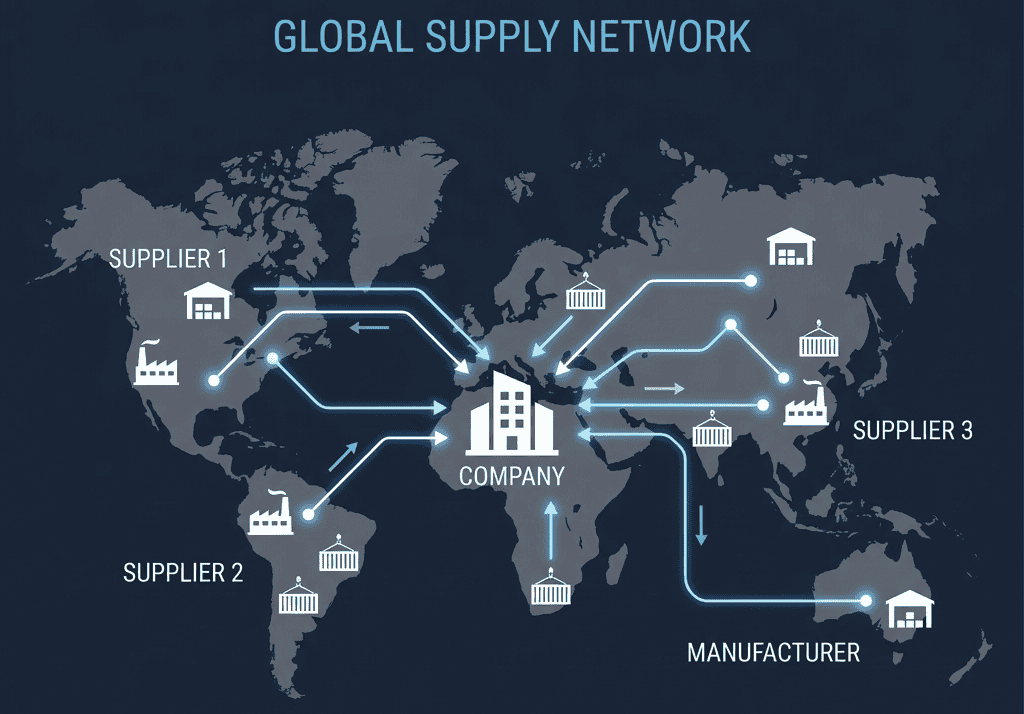
I am sure everyone remembers the 2020 toilet paper shortage. Or that time you couldn’t buy a new PlayStation for months? These incidents showed how fragile supply chains can be. Many companies depend on just one or two suppliers. When those suppliers fail to deliver, problems can arise.
But the good news is that you can now build a stronger supplier network without creating a mess. And in this article, we will look at how to do multi-sourcing the right way.
The Problem With One-Supplier Dependency

Companies that are putting all their eggs in one basket are asking for trouble. Companies should not rely on just a single supplier. Anything could happen to that one supplier. For example, factory fires, bankruptcies, and port closures. When this happens, your business will be affected as well.
According to a BCI report, nearly half of companies experienced disruptions due to supplier failures. The days of single-sourcing to save a few pennies are over. Smart businesses now know better.
What Multi-Sourcing Really Means
In multi-sourcing, you need a list of contingency suppliers. Those backup suppliers will help you build a strategic network of partners who can step up when needed.
If you do it right, multi-sourcing will give you:
- Protection against regional disasters
- Bargaining power with suppliers
- Faster response when demand spikes
- Access to different types of expertise
But if you do it wrong, it can create a management nightmare of confusing contracts, quality issues, and also higher costs.
Building Your Multi-Source Strategy
Step 1: Map Your Current Supply Chain
First, you need to get clear on what you have now. You need to identify the supplies or parts that could shut down your business if they stop arriving. And those are your critical items.
For each critical item, you need to ask the following:
- Who supplies this now?
- Where are they located?
- What risks exist in their region?
- Do we know their suppliers, too?
Many companies don’t know who their suppliers are! And this blind spot is dangerous. Map at least two or three tiers back for important items.
Step 2: Find and Vet New Partners
This is the most important part! But don’t just grab any company with a nice website. You need to look for the following, too:
- Financial stability (will they be around next year?)
- Similar quality standards
- Capacity to grow with you
- Location in a different region than your main supplier
- Good communication practices
One good trick is to ask existing suppliers for recommendations. They often know quality players in their field.
Step 3: Start Small With New Suppliers
Don’t switch 50% of your orders to a new supplier overnight; it is like asking for disaster. Instead, you can start with small test orders. Find out how they handle communication, quality, and timing before scaling up.
Some companies use a 70/30 split – 70% to their proven main supplier and 30% spread among alternatives. This keeps your primary relationship strong while building backup options.
Step 4: Create Clear Standards
The secret to managing multiple suppliers without going crazy is to follow standards! Every supplier should follow the same:
- Quality requirements
- Packaging guidelines
- Communication protocols
- Performance metrics
When everyone plays by the same rules, you can have enough information to compare apples to apples and switch between suppliers more easily.
The Tech That Makes Multi-Sourcing Work
But to make it all work, you need to have some tech to make it work. Good old spreadsheets won’t cut it anymore. You need systems that give you visibility across your supplier network.
Simple tools like shared dashboards can help everyone to see the same information. This makes switching orders between suppliers much smoother during crises.
Alerts are super helpful, too. The sooner you know about a problem at one supplier, the faster you can shift to another.
Common Mistakes to Avoid
Multi-sourcing goes wrong when companies:
- Chase the lowest price instead of the total value
- Forget to build real relationships with each supplier
- Create too much complexity with too many partners
- Don’t test their backup plans until disaster strikes
You need to remember that having 20 unreliable suppliers is worse than having 3 solid ones!