
Here’s a question worth asking. But how can you really tell if organic coffee is actually from where the label claims? Perhaps if that medicine stayed cold from the factory to the pharmacy? Most supply chains run on trust. And relying on trust alone does not always work.
That’s where blockchain in the supply chain steps in. It gives every party a clear and shared record of each step a product takes. There will be no guessing or gaps.
What Is Blockchain in a Supply Chain?
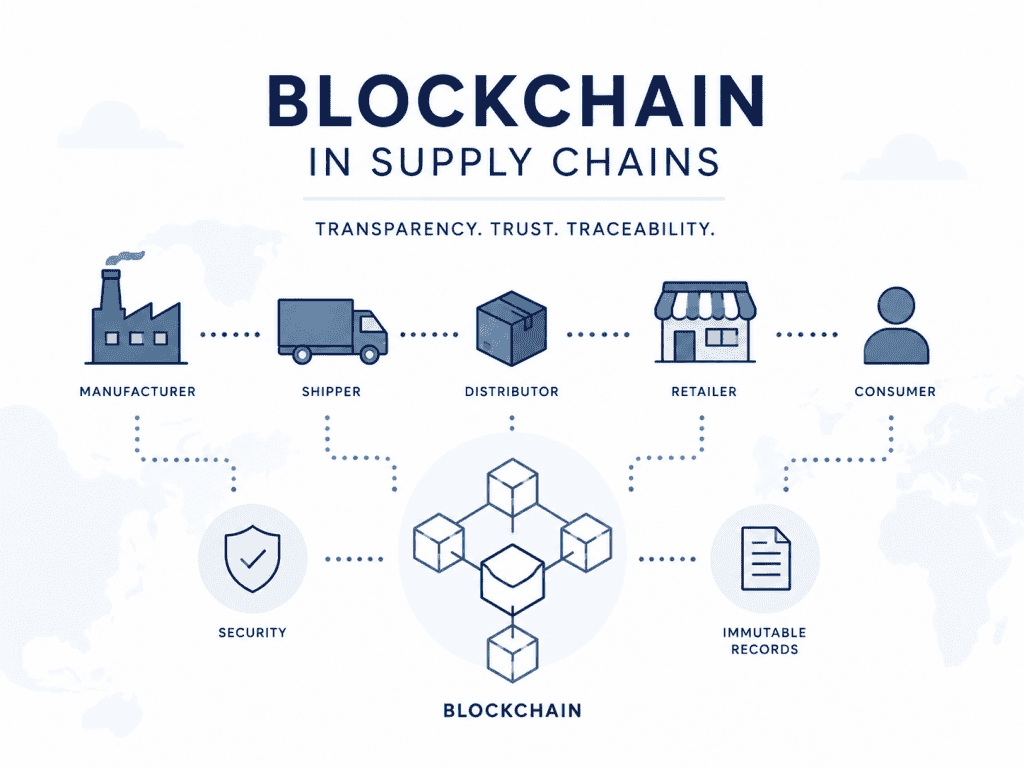
Blockchain is like a distributed digital notebook. Whenever an event occurs, such as a shipment being on the way or a payment clearing, another entry is added. That record cannot be altered or retracted after the fact. Which everybody in the chain can see.
That is a big deal in supply chains. Suppliers, shippers, retailers, and buyers all need to trust the same data. Blockchain supply chain management offers them one collaborative space from which to do it. With this system, you don’t need back-and-forth emails, and it also avoids conflicting records between parties.
Why Supply Chains Need It
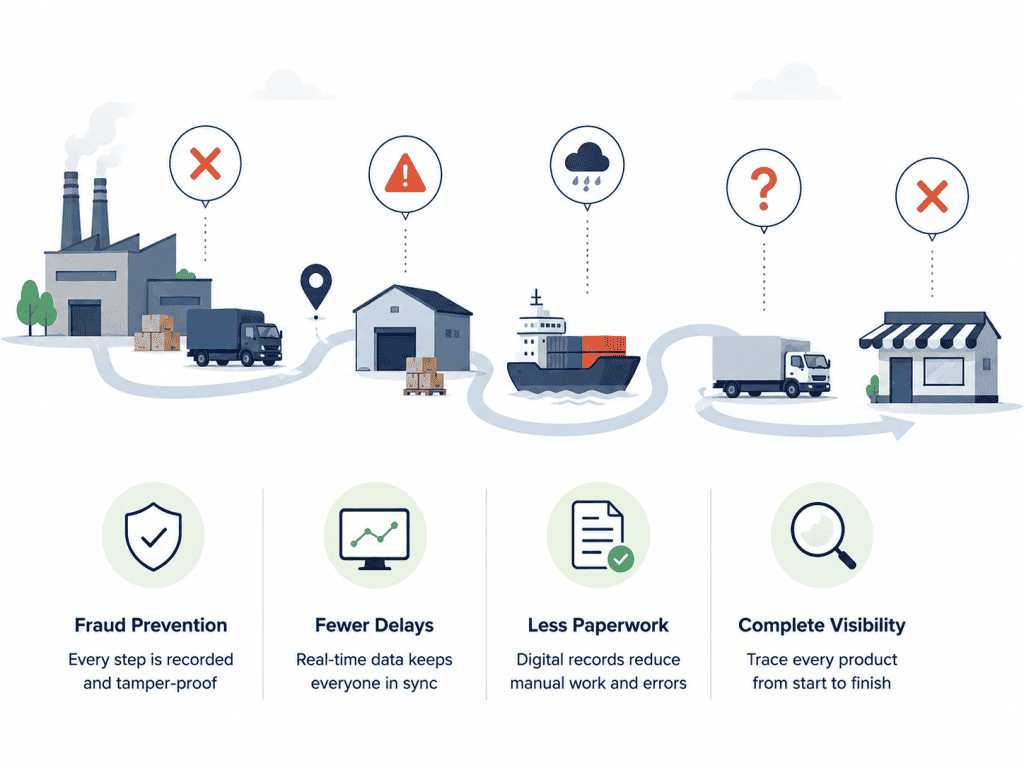
Supply chains are messy. They involve dozens of companies, countries, and handoffs. Things go wrong. Products get lost. Labels get faked. When something does go wrong, it can take weeks to trace where it started.
Blockchain traceability cuts that time way down. Say a batch of food gets flagged for contamination. You trace it back to the exact farm, exact date, and exact shipment. Fast. No finger-pointing. Just facts. Supply chain transparency like this used to be nearly impossible.
Here’s what else it solves:
- Fraud: Fake goods get harder to slip through when every step is logged and locked
- Delays: Everyone sees the same live data with no waiting for slow updates
- Paperwork: Manual documents get replaced by digital records that update on their own
Smart Contracts Do the Heavy Lifting
Smart contracts are small programs stored on the blockchain. They fire off on their own when set conditions are met. Does a shipment arrive at the right temperature? Payment goes out automatically. No delay. No dispute.
This kind of supply chain automation saves a lot of time. It also builds trust between parties who’ve never worked together before. That’s a big deal in global trade.
Real Uses Across Industries
Blockchain logistics and traceability show up in more places than you’d expect.
- Healthcare: Drug companies track medicines from factory to pharmacy. Temperature, location, and time all get logged at every stop.
- Food: Walmart uses blockchain to trace produce. A recall that used to take days now takes seconds.
- Manufacturing: Parts get tracked as they move between suppliers. Counterfeits get flagged early before they cause real damage.
Product traceability at its best means knowing not just where something is right now, but everywhere it’s been. That’s a big shift from how most supply chains have worked for decades.
Blockchain Works Better With Other Tech
Blockchain doesn’t have to work alone. Pair it with IoT sensors, and you get live data straight from shipping containers. Pair it with AI, and you spot problems before they blow up. Supply chain technology gets a serious boost when these tools team up.
A shipment of fresh dairy might have sensors logging temperature every hour. That data feeds into the blockchain. If something goes off, the system flags it right away—no wasted product. No scrambling.
The Challenges
Sadly, no technology out there comes without its share of problems. It takes time for Blockchain Supply Chain adoption to take hold. All partners in the chain need to use a unified system. That’s not always easy. And one reason is that setup costs can be tricky for smaller companies.
There’s also the human side. Because somebody has to make sure that products are labeled correctly. Whatever is recorded in the blockchain gets locked. It can’t do anything about a bad input at the start.
A Foundation Worth Building On
Supply chain security gets stronger when data can’t be altered after the fact. It also generates tangible results for companies such as those constructing on Oracle or Hyperledger platforms. There are fewer delays, lower costs, and faster recalls.
Blockchain in supply chains has moved through the hype cycle. This is a real tool that delivers accurate results. It’s getting adopted by more industries day after day. And those who haven’t yet started using it are starting to wake up.